What Happens When Replacing BCI Group24 Lead-Acid Battery with Lithium Battery in a Vehicle
Blog | September 20, 2026
Effects of Replacing a BCI Group 24 Lead-Acid Battery with a Lithium Battery in a Car
The BCI Group24 is a standard battery size defined by the Battery Council International, widely adopted for recreational vehicles, yachts, modified vehicles, and many older passenger cars. Many vehicle owners consider replacing their original Group24 lead-acid batteries with lithium batteries of the identical casing size, attracted by the lithium battery's lightweight design and longer cycle life. Although the two batteries share the same dimensional specification for plug-and-play installation, the replacement is far from a simple swap. Switching to a Group24 lithium battery brings comprehensive changes to the vehicle's power supply characteristics, electrical systems, charging mechanism, and overall safety performance.
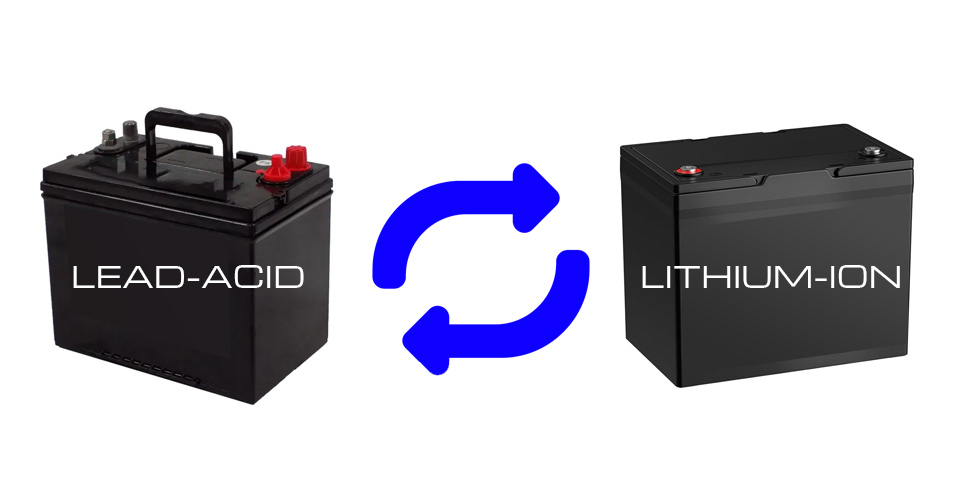
The most intuitive differences lie in physical attributes and core performance. A BCI Group24 lithium battery weighs only one-third to one-quarter of its lead-acid counterpart. The reduced overall vehicle load delivers slight improvements in vehicle condition, especially for RVs and modified vehicles that carry heavy battery units. In terms of power utilization, lithium batteries boast a far superior depth of discharge. Traditional lead-acid batteries can only safely release 50% of their rated capacity, and deep discharge will rapidly cause sulfation and permanent damage. In contrast, Group24 lithium iron phosphate (LiFePO4) batteries support a stable discharge depth of over 80%, providing substantially more usable power at the same nominal capacity. Additionally, lithium batteries offer a cycle life of more than 3,000 times, compared with merely 300 to 500 cycles for standard lead-acid batteries, greatly extending the replacement cycle and making them ideal for vehicles with long-term parking and idle power consumption. However, lithium batteries have a notable drawback in low-temperature environments, where their capacity declines significantly, performing far less stably than lead-acid batteries in cold winter conditions.
The compatibility issues with the vehicle's original charging system are the biggest pitfall of direct replacement. Vehicle alternators and voltage regulators are factory-calibrated to match the charging curve of lead-acid batteries. The standard float charging voltage for lead-acid batteries ranges from 13.6V to 14.4V, while lithium batteries require different optimal charging voltages and cut-off parameters. Direct replacement without modification leads to two common problems: insufficient charging voltage that leaves the lithium battery permanently undercharged and unable to exert its full performance, or excessive charging voltage that causes continuous overcharging, frequent tripping of the battery management system (BMS), and even irreversible damage to battery cells.
When the vehicle is idling or running, the alternator continuously supplies power to the lithium battery. Without supporting voltage reduction or isolation modules, the original voltage stabilization system cannot adapt to lithium battery charging requirements. This often triggers vehicle warning lights, unstable idling speed, and false low-voltage alarms from the factory voltage monitoring system. The risks are more severe for vehicles with auto start-stop functions. The instant high current impact during start-stop operations may cut off the lithium battery's output via BMS protection, resulting in sudden engine shutdown and onboard computer reset while driving.
Furthermore, the switch alters the operating logic of the vehicle's electrical components. Lead-acid batteries have inherent internal resistance that buffers instantaneous high-current output, ensuring mild and stable power delivery. Lithium batteries feature extremely low internal resistance and explosive instantaneous discharge current. Without a qualified built-in BMS, aging circuit lines or short-circuit faults may generate extreme current, raising the risk of overheating and fire compared with lead-acid batteries. Although standard Group24 lithium batteries are equipped with BMS to activate over-voltage, under-voltage, over-current, and over-temperature protection by cutting off power output, this hard shutdown mechanism differs drastically from the gradual voltage drop of failing lead-acid batteries. Sudden power cutoff while driving will disable vehicle lights, central control systems, and ignition devices, posing potential driving safety hazards, whereas a depleted lead-acid battery can still sustain basic power supply for a short period.
This battery upgrade also involves clear scenario trade-offs. For ordinary fuel vehicles that only use batteries for engine starting, replacing the lead-acid battery with a Group24 lithium battery is not recommended. Despite the lithium battery's sufficient peak current for starting, its high cost brings negligible practical benefits. The upgrade is only worthwhile for RVs, camping-modified vehicles, and other models with high auxiliary power demand during parking. In addition, lithium batteries require standardized professional recycling instead of casual disposal, and their upfront purchase cost is three to five times higher than equivalent lead-acid batteries.
In conclusion, BCI Group24 lithium batteries are dimensionally compatible for original-equipment replacement but cannot be installed and used directly without modifications. Safe and reliable operation requires matched BMS protection, adaptive charging modules, and recalibration of the vehicle's alternator operating parameters. The lithium battery's core advantages include lighter weight, higher available capacity, and longer service life, while its main disadvantages are poor charging system compatibility, hard power-off safety risks, low-temperature performance attenuation, and high costs. Ordinary daily-driven fuel vehicles gain little from the upgrade, while RVs and modified vehicles with heavy parking power demands can fully leverage lithium battery advantages with proper supporting modifications.
Related BCI Group Articles
BCI Group Chart

